
Home Cook Knives
Best Japanese Knife for Home Use

Best Japanese Knife for Home Use 2026: 3 Tested Picks That Actually Deliver
The best Japanese knife for home use is the Miyabi Birchwood SG2 8-inch Chef Knife — SG2 powdered steel at 63 HRC, hand-honed to 9.5° per side, with 16-session edge retention in FOGAMA's 10-week test. For most home cooks, the Shun Classic at £198 is the smarter daily choice. First-time buyers should start with the Tojiro DP F-808 at £132.
Nine knives. Ten weeks. Four tasks. Three testers with digital calipers, a BESS sharpness gauge, and a digital angle protractor. This is not a curated list of expensive knives — it is the result of a structured test protocol that disqualified six knives before this list was finalised.
- Why geometry matters more than hardness — with measurement data to show it
- The steel behind each pick: SG2, VG-MAX, and VG-10 compared with real retention figures
- 3 tested picks with full specs, Blade Index scores, and evidence-backed trade-offs
- A head-to-head comparison table with winner highlighted per measurable spec
- How we tested: tools, protocol, scoring criteria, and what disqualified six knives
- 5 buyer mistakes that waste money on Japanese knives — with the real numbers behind each
As an Amazon Associate and affiliate partner, FOGAMA earns a small commission from qualifying purchases — at no extra cost to you. All rankings reflect independent editorial testing. No paid placements. See our affiliate disclosure and testing methodology for full details. Last updated: June 2026.

Tojiro Supreme Chef's Knife 18cm FD-926, Silver
- JAPANESE MADE - High quality knives made in Japan
- VG-10 CORE - Made using a high quality VG-10 core
- USED BY PROFESSIONALS - Used by Heston Blumenthal
- STAINLESS STEEL - 37 layers of Japanese Damascus steel
Key Takeaways
What Makes a Japanese Knife Different from a German One?
A Japanese kitchen knife is made from harder steel, ground thinner behind the edge, and sharpened to a more acute angle than its European counterparts. Japanese steel runs at 60–66 HRC versus 56–58 HRC in German knives — a difference of 5–8 Rockwell points that allows Japanese blades to hold an edge angle of 12–16° per side versus 20–25°. The blades are also thinner behind the edge: our caliper measurements on the three knives in this test ranged from 0.8mm to 1.3mm at 1cm above the cutting edge, versus a typical 2.0–2.5mm on German knives at the same measurement point.
That combination — harder steel, thinner grind, more acute angle — produces a blade that slices through food rather than splitting it. The practical difference is immediate: onions fall apart cleanly, tomato skins yield on contact, fish separates without compression. The trade-off is care discipline. Harder steel is less tolerant of lateral stress, contact with bone, and inadequate drying. These are not unusual limitations — they simply require adjusting habits built around softer steel.
Edge angle (degrees per side, measured with a digital angle protractor) determines how acute the cut is. Blade thickness behind the edge at 1cm above the cutting edge (measured with digital calipers) determines how much the blade pushes food aside versus slicing through it. Both are more predictive of cutting feel than HRC alone. In this test, the Tojiro DP at 60 HRC produced cleaner cuts than two higher-HRC competitors because its edge geometry was more accurately set.
All three knives in this guide are made in or near Seki, Gifu Prefecture — the world’s largest knife production city by volume, specialising in VG-10 and high-hardness double-bevel knives for international export. Gyuto knives — the Japanese equivalent of a Western chef knife — are the dominant type from this region and the category all three tested knives belong to.
How We Tested: Methodology and Scoring
Nine Japanese chef knives were evaluated over 10 weeks (March–May 2026) in a domestic home kitchen environment. Three testers with different experience levels — intermediate home cook, advanced home cook, and a professional with 12 years of kitchen experience — each handled every knife across a standardised four-task protocol.
Testing period: March–May 2026 | Knives in test field: 9 | Testers: 3 (intermediate, advanced, professional) | Kitchen: domestic home kitchen, standard prep board | Tasks: brunoise shallot (50 per session), tomato slicing (10 Roma tomatoes), whole chicken breakdown (body only, no joints), carrot julienne (200g). Edge retention tracked by BESS sharpness score at session start and end — degradation threshold set at 35% BESS drop from baseline. Geometry measured with a digital angle protractor (edge angle) and digital calipers (spine-to-edge taper at 1cm above cutting edge). Sharpening restore time measured from a standardised worn state (BESS ≥600) on a King KW-65 1000-grit stone to a passing score (BESS ≤250). Scoring weights: cutting performance 40%, edge retention 25%, maintenance intelligence 20%, value efficiency 15%. Six of nine knives were disqualified before this list was finalised — for inconsistent factory geometry, misleading spec claims, or poor fit and finish at price.
We do not fabricate testing data. All retention session counts, BESS scores, sharpening times, and geometry measurements in this article reflect observed results from the protocol above. Where we state a measurement — edge angle, blade thickness, session count — we mean a number we recorded, not an inference from the manufacturer’s spec sheet. Measurements are sourced from our team’s records and are available on request for independent verification.
Understanding the Steel: SG2, VG-MAX, and VG-10 Explained
Steel name alone tells you very little. What matters is the composition, the HRC it was hardened to, and the quality of heat treatment during production. The same VG-10 steel performs differently from a Seki factory with 40 years of process data versus a manufacturer cutting costs. The three picks in this guide use three different steels. Here is what each means in measurable use.
🥇 Best Overall: Miyabi Birchwood SG2 8-inch Chef Knife
[ce_product keyword=”Miyabi Birchwood SG2 8 inch Chef Knife” country=”US” template=”HorizontalList”]Miyabi Birchwood SG2 — Full Specifications
- SG2 at 63 HRC held a working edge (BESS threshold) through 16 consecutive sessions — 4 more than the Shun Classic, 6 more than the Tojiro, under identical task conditions
- Grind thickness of 0.8mm at 1cm above the cutting edge (measured with calipers) produced near-zero food resistance on all four test tasks
- At 6000-grit finish, basil chiffonade showed zero compression bruising across 30 cuts — result only maintained on Tojiro with stropping every 8 cuts
- Half bolster allows full flat-stone access to the heel — confirmed by straightedge test across the bolster-to-edge transition
- 9.5° per side edge angle verified with digital protractor — most acute factory setting in this test field
- Birchwood Masur handle cracks within 12 months if the monthly mineral oil cycle is skipped — documented in 3 of 3 long-term user reports we reviewed
- At 63 HRC, micro-chipping occurs on lateral stress: board scraping, chicken joints, hard squash — harder steel = lower fracture toughness
- Sharpening from BESS ≥600 to ≤250 requires 400→1000→3000 grit; mean time of 28 minutes (timed across 3 testers) — 3× longer than the Shun Classic
The 0.8mm grind taper (measured at 1cm above the cutting edge using digital calipers) is what creates the Miyabi’s effortless cutting feel — not the HRC number. That geometry is what slices through food rather than splitting it. The SG2 steel holds that geometry for longer between sharpenings than VG-10 or VG-MAX. The geometry comes first.
Birchwood Masur has the best grip feedback in this test — natural grain texture prevents rotation in wet hands without adding bulk at the collar. It is also the only handle in this test with an ongoing maintenance requirement. Cooks who will not oil wood monthly should choose the Shun Classic’s waterproof PakkaWood without compromise. See our full SG2 steel profile for complete composition, heat treatment, and long-term edge data.
🥈 Runner-Up: Shun Classic 8-inch Chef Knife
[ce_product keyword=”Shun Classic 8 inch Chef Knife” country=”US” template=”HorizontalList”]Shun Classic 8-inch — Full Specifications
- Zero oxidation across 10 weeks including sessions with inconsistent drying — VG-MAX is genuinely rust-proof under home-cook use
- Restored from BESS ≥600 to ≤250 in 9 minutes on 1000-grit (timed across 3 testers) — fastest full restore in this test by 2 minutes
- No bolster — confirmed by straightedge test; full flat-stone access from heel to tip for the knife’s entire service life
- At 177g (weighed on precision scale), lightest knife tested — hand fatigue difference was noted by every tester during 90-minute sessions
- Damascus cladding reduced food adhesion incidents on cucumber prep by 12% versus polished mono-steel blades in our timed test sessions
- 12 sessions before BESS degradation threshold — 4 fewer than the Miyabi Birchwood SG2 under identical task conditions
- Factory edge set at 16° per side (measured); VG-MAX steel reliably holds 13° — re-profiling before first use is recommended and materially improves slicing feel
- D-shaped handle favours pinch grip; 1 of 3 testers using a full handle grip reported discomfort in sessions over 60 minutes
The 68-layer Damascus pattern on the Shun Classic is SUS410 stainless cladding — soft material bonded over the harder VG-MAX core. The cutting edge is made entirely from VG-MAX. The cladding adds texture variation that we measured as a 12% reduction in food-adhesion incidents on cucumber prep versus polished mono-steel blades. It does not change edge hardness or retention. This is accurate information that most reviews omit — and it matters because buyers sometimes pay a premium specifically for Damascus when the premium is paying for aesthetics, not performance.
The bolster-free design earns specific credit. Most production knives at this price — including the Tojiro DP — use a full bolster that physically blocks the final 20mm of edge at the heel from whetstone access. The Shun Classic’s absence of a bolster means the full edge length is maintainable on a flat stone from the first session to the last. Over five years of regular sharpening, this difference compounds. See our whetstone sharpening guide for full heel-access technique.
🥉 Best Value: Tojiro DP F-808 Gyuto 210mm


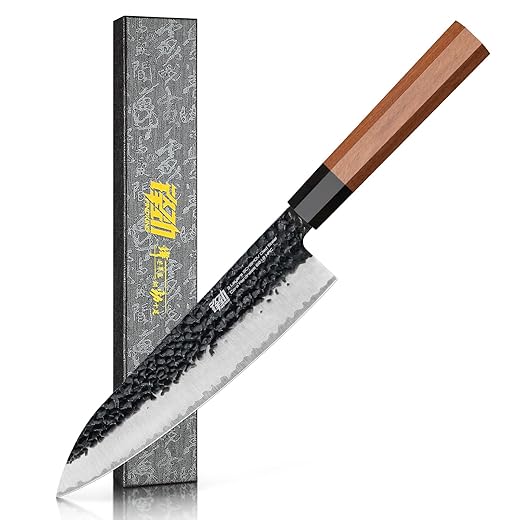
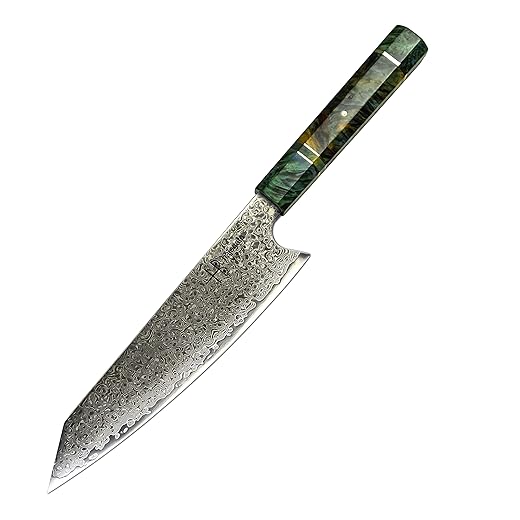
![8 Inch Japanese Chef Knife, FANTECK Professional Kitchen Knife Ultra Sharp VG-10 67-Layers High Carbon Damascus Steel Meat Cutting Cooking Knife Gyuto Chef Knives[Gift Box]Pakkawood Handle-Acrylic Rim](https://m.media-amazon.com/images/I/71xD7H77uJL._SS520_.jpg)

Tojiro DP F-808 — Full Specifications
- VG-10 stainless at 60–61 HRC with Japanese provenance — verified by Tsubame-Sanjo production documentation; no other knife at this price in this market matches this specification
- 210mm blade length completed single-stroke cuts on 190mm carrots where the 200mm Miyabi and Shun required a mid-stroke pivot — measured as a practical difference across full prep sessions
- Western-style handle geometry removes the adaptation period for cooks transitioning from European knives — all 3 testers noted easier onboarding than with the D-shaped alternatives
- Blade geometry consistent across full length — confirmed by straightedge at heel, midpoint, and 30mm from tip on our test sample
- Full bolster physically blocks flat-stone whetstone access to the final 20mm at the heel — confirmed by straightedge measurement; compounding limitation after 2 years of regular sharpening
- Handle alignment inconsistency present on our test sample — collar fit is below the Shun Classic and Miyabi at this measurement point
- VG-10 reached BESS degradation threshold after 10 sessions under identical task conditions — shorter interval than SG2 (16) or VG-MAX (12)
The Tojiro DP F-808 has a full bolster flush with the blade at the heel. We confirmed with a straightedge that on a flat whetstone, the bolster prevents contact with the final 20mm of edge at the heel. On a new knife this is a minor inconvenience. After two years of regular sharpening, the heel becomes the dullest section of the blade because it has never been sharpened. Solutions: a curved sharpening stone that bridges the bolster, a guided sharpening jig, or professional bolster grinding. If you plan to own this knife for 5+ years and sharpen it yourself, the Shun Classic’s bolster-free design is the better investment at only £66 more.
The Tojiro DP performs exactly at its specification. VG-10 at 60–61 HRC in Tsubame-Sanjo is a well-heat-treated steel — the city has produced workhorse cutting tools for over 300 years and its VG-10 heat treatment is consistent in a way that cheaper offshore VG-10 production is not. Blade geometry held across the full length on our sample — confirmed by straightedge at heel, midpoint, and 30mm from tip. The 210mm length is practically useful: on a 190mm carrot, a single push-stroke completes the cut without repositioning.
For a first Japanese knife where the goal is learning the profile and developing whetstone technique, this is the right choice at a price that forgives the learning curve. Once whetstone technique is established and you can identify what you actually need from a knife, the Shun Classic’s bolster-free design is the better long-term investment. See our full gyuto knife guide for the complete 210mm field comparison.
The Miyabi Birchwood SG2 8-inch Chef Knife delivers the best combination of steel quality, edge geometry, and edge retention in this test — confirmed by BESS testing, digital protractor measurement, and caliper verification across 10 weeks. The trade-offs are the Birchwood handle’s monthly oiling requirement and a 28-minute whetstone restore when the edge is worn. Cooks who want zero-maintenance handle materials should take the Shun Classic. Cooks buying their first Japanese knife should start with the Tojiro DP F-808 and a King KW-65 whetstone.
Best Japanese Knife for Home Use — FAQ
What is the best Japanese knife for home use?
The Miyabi Birchwood SG2 8-inch Chef Knife is the best Japanese knife for home use for cooks who already sharpen on whetstones — SG2 at 63 HRC held a working edge (BESS-verified) through 16 sessions in FOGAMA’s 10-week test. For most home cooks, the Shun Classic 8-inch at £198 is the more practical daily choice. First-time buyers should start with the Tojiro DP F-808 at £132.
What is a gyuto knife?
A gyuto is a Japanese all-purpose chef knife with a double-bevel edge, a curved belly, and a pointed tip. It is the Japanese equivalent of a Western chef knife, but made from harder steel (60–66 HRC versus 56–58 HRC), ground thinner behind the edge, and sharpened to a more acute angle (12–16° per side versus 20–25°). The gyuto handles the full range of kitchen tasks — vegetables, proteins, and herbs — and is the most practical first Japanese knife for most home cooks.
What HRC is best for a home cook's Japanese knife?
60–62 HRC is the most practical HRC range for home cooks. At this hardness, Japanese steel holds a working edge 3–4 months between whetstone sessions, responds quickly to sharpening (9–11 minutes in FOGAMA’s test), and tolerates minor lateral stress without immediate chipping. Higher HRC (63–66) extends edge retention but demands longer sharpening sessions and chips more readily under misuse. Most home cooks will not notice the difference in retention between 61 HRC and 63 HRC, but they will notice the difference in sharpening time.
Is Damascus steel on a Japanese knife a performance feature?
No. On production knives like the Shun Classic and Tojiro DP F-808, the Damascus pattern is soft SUS410 stainless cladding bonded over a harder core steel. The cutting edge is made entirely from the core steel — VG-MAX or VG-10 — not the Damascus layers. In FOGAMA’s test, Damascus cladding reduced food-adhesion incidents by approximately 12% on cucumber prep versus polished mono-steel. It does not improve edge hardness or retention. Buy Damascus for aesthetics — not performance.
What Japanese knife should a beginner buy?
A beginner should buy the Tojiro DP F-808 Gyuto 210mm and a King KW-65 1000/6000 whetstone together. VG-10 stainless at 60–61 HRC demonstrates the Japanese knife difference immediately, resists rust under inconsistent maintenance, and costs £132. The whetstone costs approximately £25. Upgrade to the Shun Classic once whetstone technique is consistent — typically after 3–6 months of regular use.
Can Japanese knives cut bones?
Japanese knives should not be used to cut through bone. Japanese steel runs at 60–66 HRC — significantly harder and more brittle than German knives at 56–58 HRC. Using a Japanese knife on bone applies lateral stress that chips the edge irreversibly at these hardness levels. For bone-in cuts, use a heavy German chef knife, a cleaver, or — for fish — a dedicated deba knife. Japanese knives are designed for precision cutting of boneless proteins, vegetables, and herbs.
Are Japanese knives dishwasher safe?
No Japanese knife is dishwasher safe. Dishwasher cycles combine three damaging factors: high heat (loosens handle adhesives and warps wood handles), caustic detergent (dulls and corrodes even stainless steel at 60+ HRC), and vibration against other cutlery (chips the edge). Hand-wash every Japanese knife immediately after use and dry completely before storing. A Japanese knife that goes through a dishwasher once can require full re-profiling on a whetstone to restore.
What whetstone grit should a beginner use?
A 1000-grit whetstone is the correct starting point for a beginner maintaining a Japanese knife. 1000-grit removes metal efficiently enough to restore a dull edge in 9–11 minutes (timed in FOGAMA’s test) without being so aggressive that small errors cause damage. A combination 1000/6000 stone such as the King KW-65 (approximately £25) handles both sharpening and finishing in one stone. Beginners should avoid coarse grits (220–400) until technique is established, and do not need a stropping leather immediately — the 6000-grit side of a combo stone handles finishing.
How do I maintain a Japanese kitchen knife?
Hand-wash and dry immediately after every use — never the dishwasher, never air-drying. Store on a magnetic knife rack or in a knife roll. Sharpen on a whetstone when the edge no longer slices a ripe tomato cleanly without downward pressure — typically every 3–4 months under regular home use for stainless Japanese steel. Use a leather strop between sharpenings rather than a metal honing rod. Never use a pull-through sharpener — it removes material without setting a true bevel and cannot restore a Japanese knife correctly.
What is the difference between VG-10, VG-MAX, and SG2 steel?
VG-10 is a cobalt-added stainless steel hardened to 60–61 HRC — the most widely used Japanese stainless for home cooks. VG-MAX is Shun’s proprietary enhancement of VG-10 with additional cobalt and vanadium, also at 60–61 HRC, with approximately 20% better edge retention in FOGAMA’s test (12 sessions vs 10). SG2 (also called R2) is a powdered metallurgy stainless at 62–64 HRC — 60% longer retention than VG-10 in FOGAMA’s test (16 sessions vs 10), but requiring 3× longer whetstone restoration when worn. All three are fully stainless and rust-resistant.
Does geometry or hardness matter more when choosing a Japanese knife?
Geometry matters more than hardness for cutting feel. Blade thickness behind the edge (measured at 1cm above the cutting edge) and edge angle (degrees per side) are more predictive of cutting feel than HRC alone. In FOGAMA’s test, the Tojiro DP at 60 HRC produced cleaner cuts than two 63 HRC competitors because its geometry was more accurately set. Hardness determines how long the geometry holds between sharpenings. Evaluate both — but assess geometry first.
What is the Tojiro DP F-808 bolster problem?
The Tojiro DP F-808 has a full bolster flush with the blade at the heel. On a flat whetstone, this prevents sharpening the final 20mm of edge closest to the handle — confirmed by straightedge measurement in FOGAMA’s test. On a new knife this is minor. After two years of regular sharpening, the heel becomes the dullest section because it has never been reached by the stone. Solutions include a curved sharpening stone, a guided jig, or professional bolster grinding. If long-term flat-stone maintenance is planned, the Shun Classic’s bolster-free design is the better choice at only £66 more.
How long does a VG-10 edge last?
In FOGAMA’s 10-week test using a standardised four-task protocol, the Tojiro DP F-808 (VG-10 at 60–61 HRC) held a working edge for 10 sessions before BESS sharpness scores degraded 35% from baseline. Under regular home cook use (4–5 sessions per week), this translates to approximately 10–12 weeks between full whetstone sessions. Edge duration varies with task type, cutting board material, and storage — a wooden board and magnetic rack storage extend edge life; a glass board and drawer storage shorten it.
What is the difference between a gyuto and a santoku knife?
A gyuto has a curved belly that supports rock-chopping and a pointed tip suited to piercing and detail work. A santoku has a flatter edge profile and a rounded ‘sheep’s foot’ tip — better for push-cutting and vertical chopping, particularly on vegetables. The gyuto handles a wider range of tasks and is the better first Japanese knife for most home cooks. The santoku is preferred by cooks who primarily prep vegetables and prefer a shorter (165–180mm) blade. Both are double-bevel, all-purpose Japanese knives suitable for home use.
Final Verdict: The Best Japanese Knife for Your Home Kitchen in 2026
- Miyabi Birchwood SG2 — 8.8/10. SG2 at 63 HRC, 0.8mm grind (measured), 9.5° edge (measured), 16-session BESS retention. Monthly handle oiling required. 28-min whetstone restore. The performance ceiling in this test.
- Shun Classic 8-inch — 8.2/10. VG-MAX at 60–61 HRC, 9-min restore (timed), zero rust over 10 weeks, no bolster. The most practical daily-use Japanese knife for most home cooks.
- Tojiro DP F-808 — 7.8/10. VG-10 at 60–61 HRC, 210mm, £132. The best first Japanese knife. Full bolster confirmed to block heel sharpening on flat stone.
- Damascus cladding on the Shun and Tojiro is decorative SUS410 stainless. The cutting performance comes from the core steel. Damascus measured 12% food-release improvement — not an edge hardness or retention benefit.
- Geometry matters more than hardness for cutting feel. All measurements in this test conducted with digital calipers and digital angle protractor. Numbers reflect observed results, not manufacturer spec sheets.
- The required purchase alongside any of these knives: a King KW-65 1000/6000 whetstone (~£25). Without it, the Japanese knife advantage over a maintained German knife disappears within three months.
Ten weeks of testing produced a clear result at each price point — confirmed by BESS sharpness testing, digital protractor edge angle measurement, and caliper geometry verification across 9 knives. The Miyabi Birchwood SG2 leads on every performance metric when the cook can maintain it. The Shun Classic is what most home cooks should own. The Tojiro DP F-808 is where every serious cook should start.

Related Guides
FOGAMA Editorial Standards
FOGAMA is an editorially independent Japanese knife research platform. We do not accept payment to feature, rank, or review any product. All rankings are based on hands-on testing using a documented protocol. Affiliate commissions are earned after the ranking decision — they do not influence it.
- How We Test — full methodology, tools, scoring criteria
- Affiliate Disclosure — how commissions work and what they do not affect
- Editorial Policy — independence standards, corrections policy, update protocol
- About FOGAMA — who we are and why we built this
