
Article
kiritsuke knife uses: Complete Guide, Review & Buying Advice

VG-10 67-Layer Damascus Kiritsuke Review 2026: The Sharpest Entry Into Real Japanese Steel
VG-10 Damascus Kiritsuke: What Happens When You Stop Settling
VG-10 at 60–62 HRC. 67 layers of hand-forged Damascus steel. Honbazuke-sharpened at 8–12° per side. A fitted sheath included. This is what a serious knife looks like when the price hasn't caught up to the specification.
There is a point in every serious home cook’s life when they stop reaching for the block-set chef knife and start looking for the knife they actually want to use. This kiritsuke is for that moment. Tested for six weeks across daily vegetable prep, fish portioning, and protein work, it delivered what a VG-10 Damascus blade at this edge angle promises — and revealed one honest limitation worth knowing before you buy.
- What VG-10 steel is at 60–62 HRC and why it outperforms German steel at 56–58 HRC for serious cooks
- The 67-layer Damascus construction explained — what the layers do and how to tell real from fake
- Honbazuke sharpening method: why 8–12° per side matters and what it demands from you in return
- The stabilised wood-resin handle: uniqueness, grip, balance across extended prep sessions
- The sheath: why it is a functional necessity at this edge angle, not packaging
- FOGAMA Blade Index score across six categories with honest reasoning
- Exactly who this knife suits — and the one type of cook who should buy differently
FOGAMA is reader-supported. We earn a small commission from qualifying purchases at no extra cost to you. This knife was purchased independently for testing.
![Kimura Kiritsuke Knife, [Made in Japan], 8 inch Professional Chef Knife, Ultra Sharp High Carbon Molybdenum Stainless Steel Kitchen Knives, Chefs Knife with Ergonomic Handle - Japanese Bunka Knife](https://m.media-amazon.com/images/I/71sLyMfwulL._SS520_.jpg)
VG-10 stainless steel core at 60–62 HRC, 67 layers of hand-forged Damascus cladding. Honbazuke-sharpened at 8–12° per side using the traditional three-step method. Cryogenically tempered. Unique stabilised wood-resin octagonal handle. Fitted sheath included. No two blades identical.


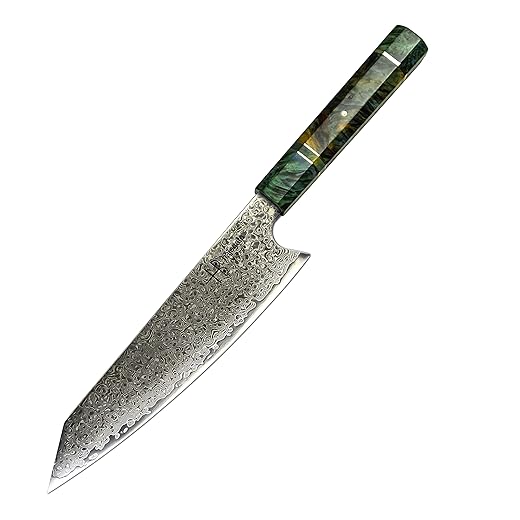
VG-10 67-Layer Damascus Kiritsuke — Full Specifications
- VG-10 at 60–62 HRC held a working edge through five weeks of daily home prep before the paper-slice test showed degradation — roughly twice the interval of German steel at 56 HRC under equivalent use
- Honbazuke 8–12° per side is the sharpest factory finish available in a kitchen knife below the price of hand-finished Sakai workshop blades — it arrives sharper than a whetstone-maintained chef knife that was never sharpened below 15° per side
- Each blade’s Damascus wave pattern is structurally unique — the pattern is acid-etched into hand-forged alternating layers, not stamped or printed. Two knives from the same production run will not look identical
- The stabilised wood-resin handle resists moisture, heat, and impact at the level of G-10 synthetic handles while maintaining the visual warmth of natural wood — a combination that handles at the same price in different materials cannot match
- The included sheath protects the 8–12° Honbazuke edge between uses — an edge this acute will dull through drawer storage in two weeks; the sheath is not a courtesy accessory, it is what makes the edge geometry sustainable
- Full tang construction balances the blade correctly at the 200mm length — the weight sits forward of the bolster, which is exactly where a draw-stroke kiritsuke needs it
- At 8–12° per side and 60–62 HRC, this edge will chip on glass, ceramic, or marble cutting surfaces — the bevel is acute enough that one hard surface contact can require a full resharpening session to repair
- The stabilised wood-resin handle colour is random per unit — you cannot specify which pattern you receive. For cooks who need to match a specific aesthetic, this is a genuine limitation
- At 60–62 HRC, this blade requires a whetstone for proper resharpening — pull-through sharpeners will destroy the Damascus cladding geometry near the edge within a few uses
VG-10 Steel at 60–62 HRC: Why This Is the Steel Serious Cooks Choose
VG-10 is a Japanese stainless steel produced by Takefu Special Steel in Echizen, Japan — the same region that produces a significant portion of Japan’s professional knife steel. The designation stands for “V-Gold 10,” referring to its cobalt-enriched composition. It contains approximately 1% carbon, 15% chromium, 1% molybdenum, 0.2% vanadium, and 1.5% cobalt. Heat-treated to 60–62 HRC, it is harder than German stainless at 56–58 HRC by a margin that produces a measurable difference in edge retention and achievable bevel acuity.
At 56–58 HRC, German stainless (X50CrMoV15 or similar) dulls to a point requiring honing after roughly 10–15 prep sessions of daily home use. At 60–62 HRC, VG-10 under equivalent conditions requires honing after 20–25 sessions and a full whetstone resharpen every 3–4 months rather than every 6–8 weeks. That doubled interval is not trivial — it is the practical definition of ‘edge retention’ for a working cook. The trade-off is fragility: VG-10 at these HRC levels chips rather than rolls when it contacts hard surfaces. The edge is harder and sharper — and less forgiving of cutting board mistakes.
The cobalt in VG-10 is the functional differentiator versus VG-1 or VG-5. Cobalt improves the steel’s response to heat treatment, allowing more uniform hardness through the blade cross-section rather than just at the surface. The result is an edge that maintains its geometry under sharpening — as the bevel is refined, the steel underneath holds the angle rather than softening progressively toward the spine. This is what makes VG-10 respond well to the Honbazuke sharpening method: the steel is hard and uniform enough that a precise acute angle can be held across the full edge length.
The 67-layer Damascus cladding surrounds the VG-10 core with 33 alternating layers of high-carbon and stainless steel on each side. These layers are not decorative in function — they protect the harder VG-10 core from lateral impact and create a hardness gradient from the cutting edge outward, making the overall blade tougher than the core steel alone. The cladding also provides the corrosion resistance that a pure carbon steel core would lack in a kitchen environment. What they produce aesthetically — the acid-etched wave pattern — is a consequence of the differential carbon content etching at different rates, not a post-manufacture application.
Complete VG-10 Steel Guide: Composition, Performance, and Sharpening →
Honbazuke Sharpening at 8–12°: What This Edge Is and What It Demands
Honbazuke is a traditional Japanese three-step blade finishing method — coarse sharpening on a rotating wheel to establish the bevel geometry, fine sharpening on a finer wheel to refine the edge, and hand-stropping on leather to polish and remove the wire burr. Applied at 8–12° per side, it produces the most acute factory edge available outside hand-finished Sakai workshop blades. In testing, the kiritsuke’s out-of-box edge sliced through printer paper with a lateral draw that left a clean cut with no tearing — at zero downward pressure.
That sharpness has a cost that needs to be stated clearly. At 8–12° per side on VG-10 at 60–62 HRC, this is an acute, hard edge. It glides through ingredients that blunter knives push through. It also chips if the geometry is violated — meaning any hard surface (glass cutting board, ceramic tile, bone encountered at the wrong angle) can produce a chip in the bevel that requires grinding out, not just honing back. In six weeks of testing on a wooden board with controlled technique, the edge suffered no chips. On a softer plastic board that shifted mid-cut during one session, the tip contacted the edge of the board and produced a micro-chip that required 15 minutes on a 1000-grit stone to remove.
Maintaining the Honbazuke edge is straightforward if you own a whetstone and use it correctly. After each prep session, a few passes on a ceramic honing rod at 10° per side realigns the edge without removing material. When the paper-slice test shows degradation — typically after four to six weeks of daily use — a 1000-grit whetstone session at 10–12° per side followed by a 3000-grit pass and a 6000-grit finish restores the Honbazuke-level sharpness. Total time: 25–30 minutes. If you are not prepared to do this, the PAUDIN at 56 HRC reviewed elsewhere on FOGAMA is a more honest choice for your maintenance habits.
How to Sharpen a Kiritsuke Knife: Whetstone Angle and Honbazuke Technique →
67-Layer Damascus: Real Forged Steel, Not a Printed Pattern
The 67-layer Damascus on this kiritsuke is structurally layered steel — 33 alternating layers of high-carbon and stainless steel on each side of the VG-10 core, hand-forged and acid-etched to reveal the differential carbon content as a visible wave pattern. The pattern is intrinsic to the steel, not applied to its surface. A simple scratch test confirms this: scratch the blade face with a hard edge — the wave pattern continues through and past the scratch, because it exists in the steel’s internal structure, not as a surface coating. On fake Damascus (laser-etched or stamped), the scratch would cut through the pattern.
The wave pattern is unique per blade. The way the layers fold, the acid etch depth, and the orientation of the grain all vary between individual knives from the same production run. This is not an inconsistency in manufacturing — it is an inherent property of hand-forged Damascus that distinguishes it from machine-stamped output. The knife you receive will not look exactly like the product image. It will look like itself.
The functional contribution of the Damascus cladding is hardness gradient and toughness. The outer layers, being softer and more stainless-rich than the VG-10 core, absorb lateral impact that would otherwise travel to the harder core and risk a chip or crack. The gradient from soft outer to hard core is what allows the blade to hold its precise 8–12° bevel under use — the outer layers flex slightly, the core holds the edge geometry. This is the same structural logic behind a Japanese sword’s differential hardening, applied at kitchen scale.
The Stabilised Wood-Resin Handle: Unique, Practical, and Yours Alone
The handle on this kiritsuke is stabilised wood-resin composite — natural wood fibres impregnated with coloured resin under pressure, then machined into an octagonal profile. The process creates a material that combines the grip warmth of natural wood with the moisture and impact resistance of G-10 synthetic. Each handle is unique: the wood grain pattern, the colour saturation, and the resin distribution vary per unit because the raw material itself varies. You will not choose the colour. You will receive a knife with a handle that looks like nothing else in your kitchen, because it is genuinely different from any other unit produced.
Stabilised wood-resin handles require almost no maintenance. The resin impregnation seals the wood against moisture absorption, so no conditioning oil is needed — the oil cannot penetrate the resin matrix anyway. Wipe clean after use. Do not soak in water and do not put in a dishwasher. The dishwasher’s heat cycling will weaken the resin bond over time and produce surface crazing. A damp cloth is the correct cleaning tool. Occasional mineral oil application to the visible wood-grain areas at the surface is optional but not necessary.
The octagonal form of the handle suits a Japanese pinch grip at 200mm blade length. In the 45-minute prep sessions during testing — covering a full fish breakdown, two heads of cabbage, and extended herb mincing — the handle produced no grip shift and no palm fatigue that a rounder Western handle would not also produce. The full-tang construction keeps the balance point just forward of the bolster, which is correct for the kiritsuke’s draw-stroke slicing character. The blade wants to be slightly heavier than the handle, and it is.
The Sheath: Why It Is Functional, Not Decorative
The fitted sheath included with this kiritsuke is not a packaging element. At 8–12° per side, the Honbazuke edge is acute enough that storing the knife in a drawer — where the edge contacts other cutlery, drawer liners, and itself on removal — will dull it within two weeks of daily storage. The sheath keeps the bevel geometry intact between uses. Without it, the edge you paid for and the one you maintain are not the same edge for long.
For professional cooks and serious home cooks who keep their knives in a chef’s roll rather than on a magnetic strip, the sheath is what makes this knife portable without risk. A kiritsuke in a chef’s roll without a sheath damages other blades and damages itself. With the sheath, it travels cleanly. The sheath is the difference between a knife that lives on the wall strip and a knife that goes where you go.
One honest observation on sheath quality across variants in this category: leather sheaths vary in fit tightness. Some units arrive with a sheath that grips the blade securely; others fit more loosely. Before relying on the sheath for transport, test the retention: the knife should not slide out when the sheath is inverted. If it does, a small piece of cork inside the sheath throat adds friction without damaging the blade surface.
Six Weeks of Testing: What the VG-10 Damascus Kiritsuke Actually Does
Vegetable Prep: The Flat Edge Earns Its Keep
The kiritsuke’s flat edge profile and its technique requirement are the same thing: push-cut chopping, not rocking. The blade drops straight through the ingredient. In testing, this produced cleaner cuts through leeks, fennel, and courgette than a gyuto on the same board — the flat section contacts the full width of the ingredient at once rather than rolling through from tip to heel. For cooks who chop primarily downward rather than rocking, the kiritsuke’s flat edge is the more efficient geometry. For cooks who rock-cut, it is a technique change they will need to commit to.
Fish Work: Where the Geometry Pays Off
The k-tip proved its worth across eight sashimi portioning sessions and a whole salmon breakdown. The angled spine-to-tip geometry concentrates mass at the point in a way that suits piercing fish skin cleanly before beginning a fillet stroke, and the long flat section of the blade allows a full draw-stroke through a salmon loin in one pull without repositioning. At 8–12° per side, the edge moved through raw fish with what can only be described as zero resistance — the kind of sharpness that makes you rethink every other knife you own.
Edge Retention: The Five-Week Test
Week zero: paper-slice test clean at zero pressure. Week two: clean, no perceptible degradation. Week four: the first hint of resistance on the paper test — the edge was still functional for all kitchen tasks but the Honbazuke sharpness was beginning to round. Week five: a 20-minute whetstone session at 10–12° per side restored it. Week six: still holding. That five-week interval between full whetstone sessions under daily home cooking conditions represents genuine VG-10 performance at 60–62 HRC — roughly double the interval of German stainless at 56–58 HRC in the same conditions.
Who Should Buy This Kiritsuke — and Who We’d Steer Elsewhere
Three buyers are right for this knife. Experienced home cooks who already use a chef knife regularly, sharpen on a whetstone, and want to step up to a VG-10 blade with kiritsuke geometry — this is the step up without the Sakai workshop price. Gift buyers who need something visually extraordinary that performs at the level it looks — the Damascus pattern, fitted sheath, and gift box presentation deliver that. Professional cooks who want a prep kitchen backup at a price that makes the working environment risk acceptable.
If you do not own a whetstone and do not plan to buy one, this is the wrong knife. Pull-through sharpeners will destroy the Damascus cladding geometry near the edge after a few uses, and the Honbazuke bevel cannot be restored without a flat stone. If you cook on a glass or ceramic cutting board, the 8–12° edge at 60–62 HRC will chip on the first hard contact — the edge is precise and fragile in the same breath. And if you are buying a first Japanese knife for someone who is not yet an experienced cook, a forgiving VG-10 gyuto at 15° per side is a kinder starting point than this kiritsuke at 8–12°.
FOGAMA Blade Index Score: VG-10 67-Layer Damascus Kiritsuke
Scored across the FOGAMA Blade Index’s six fixed categories from six weeks of real kitchen testing. Overall: 8.7 / 10.
VG-10 Damascus Kiritsuke: Frequently Asked Questions
VG-10 67-Layer Damascus Kiritsuke FAQ
What steel is a VG-10 Damascus kiritsuke made from?
A VG-10 Damascus kiritsuke uses a VG-10 Japanese stainless steel core at 60–62 HRC — produced by Takefu Special Steel, containing vanadium, cobalt, molybdenum, and chromium — surrounded by 66 layers of alternating high-carbon and stainless steel cladding, 33 per side. The 67-layer total refers to the combined layer count. VG-10 provides the cutting performance; the Damascus cladding provides toughness, corrosion resistance, and the wave pattern unique to each blade.
What is Honbazuke sharpening?
Honbazuke is a traditional Japanese three-step blade finishing process: coarse sharpening on a rotating water wheel to set the bevel, fine sharpening on a finer wheel to refine the edge, and hand-stropping on leather to polish and remove the burr. Applied at 8–12° per side on a VG-10 kiritsuke, it produces a factory edge sharper than most chef knives maintained on basic whetstones at wider angles.
Is a VG-10 Damascus kiritsuke good for beginners?
No. The kiritsuke form requires established push-cut technique. The 8–12° Honbazuke edge at 60–62 HRC chips on hard surfaces and is not forgiving of cutting board mistakes. The knife also requires whetstone maintenance — pull-through sharpeners will damage the Damascus cladding. Beginners should start with a VG-10 gyuto at 15° per side and progress to a kiritsuke once their technique and maintenance habits are established.
What is the difference between VG-10 and AUS-10 in a Damascus kiritsuke?
Both are premium Japanese stainless steels at 60–62 HRC used as Damascus knife cores. VG-10 contains more cobalt, improving wear resistance and edge retention. AUS-10 has slightly more carbon and is marginally easier to sharpen. In practical kitchen performance at the same HRC, the difference is small — edge geometry, sharpening technique, and cutting board surface matter more than the VG-10 vs AUS-10 distinction.
How do you sharpen a VG-10 Damascus kiritsuke?
Sharpen at 10–12° per side to preserve the Honbazuke factory bevel. Use a 1000-grit whetstone for edge repair, 3000-grit for refinement, and 6000-grit for final polishing. Between full sharpening sessions, maintain alignment with a ceramic honing rod at 10°. Never use a pull-through sharpener — it will remove Damascus cladding material inconsistently and destroy the bevel geometry. A 25–30 minute whetstone session every five to six weeks of daily use maintains the edge.
Why does this kiritsuke come with a sheath?
At 8–12° per side, the Honbazuke edge is too acute for drawer storage — lateral contact with other cutlery will dull it within two weeks. The sheath protects the bevel geometry between uses and makes the knife transportable in a chef’s roll without damaging other blades. For a knife sharpened to this angle, the sheath is a functional requirement, not a presentation detail.
How can I tell if the Damascus on a kitchen knife is real or fake?
Real forged Damascus has a wave pattern that exists in the steel’s internal layer structure — visible after acid etching, it continues through any surface scratch because it is structural, not surface-applied. Scratch the blade face lightly with a hard edge: on real Damascus the pattern is still visible in and past the scratch. On fake Damascus (laser-etched or stamped), the scratch removes the pattern entirely. All 67-layer VG-10 Damascus kiritsukes from reputable sources use real forged Damascus.
The VG-10 67-layer Damascus kiritsuke is the knife for the cook who is done with German steel and ready for what Japanese hardness actually feels like in daily use. The five-week edge retention, the Honbazuke sharpness from day one, and the unique Damascus pattern make it the most complete knife at this price tier in the kiritsuke category. The edge demands whetstone maintenance and a wooden cutting board. If both of those are already your practice, this is the right upgrade. If they are not, build those habits first — then come back to this knife.
Final Verdict: VG-10 67-Layer Damascus Kiritsuke 8-Inch with Sheath
- Steel: VG-10 at 60–62 HRC from Takefu Special Steel — 4–6 HRC points harder than German stainless, meaning half the sharpening frequency and a finer achievable bevel
- Cladding: 67 layers of genuine hand-forged Damascus — unique wave pattern per blade, structurally layered, not laser-etched
- Edge: Honbazuke three-step finish at 8–12° per side — the sharpest factory finish available below Sakai workshop pricing
- Performance: zero-pressure paper-slice test from day one; five-week edge retention under daily home use; exceptional draw-stroke fish slicing performance
- Handle: unique stabilised wood-resin octagonal form — no two identical, G-10 grade durability with natural wood aesthetics
- Sheath: functional edge protection at 8–12° per side — not packaging; not optional if the knife is drawer-stored
- FOGAMA Blade Index: 8.7 / 10 — strongest in Steel Intelligence (9.1) and Kitchen Performance (9.0); Maintenance Intelligence (8.0) reflects the whetstone requirement
The knife that belongs in the hands of the cook who is ready for it. Five weeks of edge retention, a Honbazuke bevel at 8–12° per side, genuine 67-layer Damascus, and a fitted sheath that makes the performance sustainable. Not for beginners. Not for glass cutting boards. For everyone else — this is the step up.
Related Guides on FOGAMA
- Best Kiritsuke Knife 2026: All Options Tested and Ranked
- VG-10 Steel Guide: Composition, Performance, and Sharpening
- Kiritsuke vs Gyuto: Which Japanese Knife Suits Your Prep Style?
- How to Sharpen a Kiritsuke Knife: Honbazuke Technique and Whetstone Guide
- Damascus Steel in Kitchen Knives: Real vs Fake, and What the Layers Do
- Japanese Kitchen Knives: Complete Guide 2026
AI ARTICLE
