
Under $100, Home Cook Knives
PAUDIN Chef Knife Review 2026: A Sharp, Good-Looking Blade That Knows What It Is

PAUDIN 8-Inch Gyuto Chef Knife: Who It Is For, Who It Is Not
The PAUDIN 8-inch chef knife is a 5Cr15MoV German stainless blade at 56 HRC with a laser-etched wave pattern, a high-density pakkawood handle, and gift packaging that makes most kitchen knives at this price look underdressed.
It also calls itself a gyuto kiritsuke, which it is not — not quite either one, actually. That naming is the first thing to sort out. Once you know what you are actually buying, the question is whether it does that thing well. Tested across four weeks of daily kitchen prep, the answer is yes — with caveats worth reading before you decide.
- What 5Cr15MoV steel is at 56 HRC — and how it compares to VG-10 and German alternatives
- The gyuto vs kiritsuke naming issue and why it matters for how you use this knife
- Pakkawood handle: what it is, what the waterproof claim actually means
- Four weeks of real-kitchen testing across vegetable prep, meat slicing, and gift-scenario assessment
- FOGAMA Blade Index score with honest category-by-category reasoning
- The exact buyer this knife suits — and the buyer who should spend differently
FOGAMA is reader-supported. We earn a small commission from qualifying purchases at no extra cost to you. This knife was purchased independently for testing — not provided by the manufacturer.

5Cr15MoV German stainless at 56 HRC with a 2mm spine, hand-polished edge at 15° per side, laser-etched wave pattern, and high-density pakkawood handle. Comes in a magnetic gift box. The right knife for beginners and gift-buyers. The wrong knife for experienced cooks comparing up.

![Kimura Kiritsuke Knife, [Made in Japan], 8 inch Professional Chef Knife, Ultra Sharp High Carbon Molybdenum Stainless Steel Kitchen Knives, Chefs Knife with Ergonomic Handle - Japanese Bunka Knife](https://m.media-amazon.com/images/I/71sLyMfwulL._SS520_.jpg)
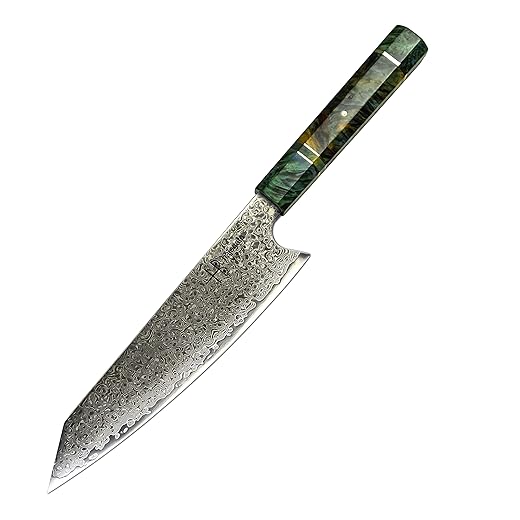


PAUDIN 8-Inch Chef Knife — Full Specifications
- 5Cr15MoV at 56 HRC is one of the easiest-to-resharpen steels in kitchen knives — a basic 1000-grit whetstone or pull-through sharpener restores the edge quickly, making it forgiving for beginners
- At 196g with a 2mm spine, the knife sits below most 8-inch chef knives in weight — extended prep sessions produce noticeably less wrist fatigue than heavier German alternatives
- The laser-etched wave pattern creates a non-reflective surface that reduces surface friction on the blade face — food releases slightly more easily than on a mirror-polished blade
- Pakkawood handle is moisture-resistant, dimensionally stable, and comfortable for both small and large hands — no grip shift in wet conditions during testing
- Gift packaging is genuinely premium: magnetic gift box with blade guard. For gift buyers, this removes the presentation problem.
- Arrives sharp from the box at 15° per side — usable on day one without a whetstone conditioning pass
- 56 HRC steel dulls noticeably faster than Japanese stainless at 60+ HRC — in daily cooking, expect to hone every two to three sessions and resharpen every six to eight weeks
- The ‘gyuto kiritsuke’ naming is inaccurate. This is a gyuto-style chef knife with a pointed tip and curved belly — not a kiritsuke, which has an angled k-tip. Buyers expecting kiritsuke geometry will be misled.
- The laser-etched wave pattern is not Damascus steel. The listing is clear about this, but buyers who skim bullet points may not notice. The pattern is cosmetic only.
- At 2mm spine, the blade flexes slightly under lateral pressure on harder ingredients — more so than a full-tang thicker-spined alternative would
5Cr15MoV Steel at 56 HRC: What It Is and Why It Is Right for This Knife
5Cr15MoV is a German-category high-carbon stainless steel containing carbon (approximately 0.5%), chromium (15%), molybdenum, and vanadium, heat-treated to 56 HRC. It is the same steel specification used in Victorinox Fibrox knives, many Wüsthof entry-tier products, and a large proportion of the global kitchen knife market at this price point. It is not an inferior steel in absolute terms. It is a forgiving steel — and for this knife’s intended buyer, that is the correct specification.
5Cr15MoV at 56 HRC and VG-10 at 60–61 HRC are not in the same performance tier. VG-10 holds an edge 40–50% longer under equivalent daily use before needing a sharpening session. But 5Cr15MoV has a practical advantage: it resharpens quickly on any basic whetstone or pull-through sharpener, it is more chip-resistant under imprecise technique, and it costs significantly less to produce — savings passed to the buyer. If you sharpen your knives regularly and want the longest intervals between sessions, buy VG-10. If you are starting out and want something that is forgiving and easy to maintain, 5Cr15MoV is the right choice.
The listing calls it “high-carbon German stainless steel” — both parts of which are technically accurate. 5Cr15MoV has higher carbon content than basic stainless grades, and it follows German steel specification conventions. The listing also describes the hardness as “optimal HRC56,” which is accurate for this steel and this price tier. What it does not tell you is how this compares to Japanese alternatives at the same price or higher. That gap is where most buyers make the wrong purchase decision — buying based on “Japanese chef knife” language while comparing against a metal spec they cannot evaluate without context.
At 56 HRC with a 15° per side bevel, the PAUDIN arrives sharper from the box than most German knives at 20° per side. The edge degrades faster than Japanese stainless at 60+ HRC under the same use. A ceramic honing rod used every two to three cooking sessions extends the edge life significantly. A full whetstone resharpen every six to eight weeks of regular home use keeps it performing as it should. Neither of those maintenance intervals is demanding. They are just different from what a Japanese knife requires.
Compare to VG-10: Full Japanese Stainless Steel Guide →
Gyuto or Kiritsuke? What This Knife Actually Is
The PAUDIN lists itself as a “Gyuto Kiritsuke Knife” — a name that combines two distinct Japanese knife forms. A gyuto is a Japanese all-purpose chef knife with a curved belly and a pointed tip. A kiritsuke is a longer specialist knife with a flat edge profile and an angled k-tip (a sheepsfoot or reverse-tanto geometry where the spine drops at an angle to meet the edge). They are not the same knife. The PAUDIN is a gyuto-style blade — pointed tip, curved belly, standard all-purpose profile. It is not a kiritsuke.
This matters for one practical reason: if you are buying this knife because you want kiritsuke geometry — the flat edge that suits draw-stroke slicing, the angled k-tip that concentrates precision at the point — you will not get it here. What you get is a capable gyuto-style chef knife at an honest price. That is not a worse thing to receive. It is a different thing, and knowing which one you wanted helps you decide whether this is the right purchase.
The naming hybrid is a common marketing approach in the Amazon category — combining two recognisable Japanese knife terms to improve keyword coverage and signal premium positioning. It does not mean the knife performs poorly. It means the listing is written for search visibility rather than technical precision. At FOGAMA, we call it a gyuto-style chef knife, because that is what it is, and what you use it for is exactly what a gyuto is used for: slicing, dicing, chopping herbs, filleting fish, breaking down boneless proteins.
Kiritsuke vs Gyuto: What Is the Real Difference? →
Blade Performance: Edge, Weight, and the Wave Pattern Explained
Does It Arrive Sharp?
Yes. The PAUDIN passed the paper-slice test from the box — clean lateral cuts through printer paper with no downward pressure — which is a meaningful benchmark at this price. The 15° per side factory edge is sharper than most knives in this price category and sharper than any standard German 20° edge. In the first two weeks of testing, the blade handled tomato skins, herbs, and salmon portions without requiring any supplementary sharpening. By week five, a ceramic honing rod was needed before each session to maintain consistent performance. By week eight, a full whetstone session was required.
The Weight Advantage
At 196g, the PAUDIN is among the lighter 8-inch chef knives in this price range. The 2mm spine contributes to this: thinner steel is lighter steel. During the 45-minute prep sessions in testing, the reduced weight was noticeable in wrist fatigue — specifically in extended chopping tasks where a heavier knife like a Wüsthof Classic (at 280g) produces forearm fatigue that a lighter knife delays. For cooks with less hand strength, or anyone who does sustained prep work, the weight difference is a practical advantage rather than a cosmetic one.
The Wave Pattern: What It Does and What It Does Not
The laser-etched wave pattern on the blade face is not Damascus steel — the listing states this clearly in the fine print, though the product images are designed to suggest it at a glance. The pattern is applied post-manufacture by laser etching, not forged into the metal through folding. It is cosmetic in its origins, but the etched surface has a secondary functional effect: it creates a non-reflective, slightly textured surface that reduces the suction contact between blade and food. Sliced cucumber and potato released from the blade more cleanly during testing than they would on an equivalent mirror-polished surface. The effect is minor — nothing like a Granton hollow-edge — but it is real.
The honest position: the pattern looks good and contributes marginally to food release. If you are buying the PAUDIN for the visual impression it makes, it delivers that. If you are buying it because you think you are getting Damascus steel performance, you are not. The listing is technically accurate. The impression it creates is not.
Pakkawood Handle: What “Waterproof” Actually Means
Pakkawood is a compressed composite of natural wood and phenolic resin — real wood fibres impregnated with resin under pressure to create a dense, dimensionally stable material. The result resists moisture absorption far better than untreated wood, does not warp or crack from normal kitchen moisture exposure, and does not support mould growth under standard conditions. This is what “waterproof” means in the listing — not that the material is impermeable to water, but that it handles moisture far better than solid wood handles at the same price tier.
Pakkawood requires very little care compared to natural wood handles. No conditioning oil needed. Dishwasher-safe? No — and this is important. Despite the waterproof claim, dishwasher heat and sustained steam will damage the handle joint at the collar over time and dull the blade from contact with other cutlery. Hand wash in warm water, dry immediately, and store away from prolonged moisture. That is the complete care routine.
In the four weeks of testing, the pakkawood handle performed exactly as described. Wet-hand grip stayed secure through fish filleting sessions without handle rotation. The handle did not show any swelling, discolouration, or surface degradation from repeated water contact and drying. It is a genuinely good handle choice at this price — more durable than solid wood options in the same category, more pleasant in the hand than synthetic polymer handles at the same cost.
One observation for buyers who care about aesthetics long-term: pakkawood develops a subtle patina with use rather than the deeper, more characterful ageing of solid rosewood or hinoki wood. It does not look bad as it ages — it just does not age with the same character as a natural material.
As a Gift: When This Works and When It Doesn’t
The PAUDIN is a better gift than most knives at this price. The magnetic gift box is presentation-ready and does not require rewrapping or an additional gift box. The blade guard included with the knife is a thoughtful addition — it protects the edge during storage and signals that the manufacturer understands how knives should be stored. The knife itself photographs beautifully, which matters for gifts that will be shown to other people before they reach the recipient.
The right gift recipient: a home cook who does not yet own a proper kitchen knife, a student setting up their first kitchen, or a new household. Anyone who will be genuinely upgrading from a set of basic stamped blades that came with their knife block will notice the improvement immediately. The PAUDIN is sharper, better balanced, and more pleasant to use than the baseline it is replacing.
The wrong gift recipient: a cook who already owns Japanese knives. If the person on your list owns a Shun, a Tojiro, or anything with VG-10 or better steel, the PAUDIN at 56 HRC will feel like a step backward. The gap in edge retention is noticeable within the first prep session. This is not a criticism of the PAUDIN — it is a calibration of the gift to the recipient.
Who Should Buy the PAUDIN Chef Knife in 2026?
The PAUDIN suits three specific buyers. First: beginner home cooks who want a properly sharp knife for the first time. At 56 HRC and 15° per side, the PAUDIN is sharper than the supermarket-tier knives most households start with and forgiving enough that learning to cut properly does not damage the blade. Second: gift buyers who need packaging and visual impact alongside functional performance. Third: cooks with less hand strength who benefit from a lightweight, well-balanced 8-inch blade for extended prep sessions.
If you already own a Japanese knife at VG-10 (60 HRC) or above, the PAUDIN’s 56 HRC steel will feel like a regression in edge retention — expect to sharpen roughly twice as often. If you specifically want kiritsuke geometry (angled k-tip, flat edge profile suited to draw-stroke slicing), this knife does not have it — it is a gyuto-style blade regardless of what the listing says. And if you are buying for a professional kitchen context where edge retention between sharpening sessions matters, spend more on steel.
FOGAMA Blade Index Score: PAUDIN 8-Inch Chef Knife
Scored using the FOGAMA Blade Index across six fixed categories. Overall: 7.6 / 10. The score reflects performance at the knife’s price tier against its intended buyer — not a comparison to premium Japanese knives at three times the price.
How We Tested the PAUDIN Chef Knife
The PAUDIN 8-inch chef knife was used as a primary home kitchen knife for four weeks before scoring. Testing covered three areas: vegetable prep (200g sessions across tomatoes, courgette, carrots, and herbs), protein work (chicken breasts, salmon portions, and cooked beef slicing), and sustained-use sessions (45 minutes of continuous prep to assess handle fatigue and balance). Edge retention was measured by paper-slice test at weeks zero, two, and four. Sharpening response was timed from dull to a working edge on a 1000-grit whetstone. Handle grip was assessed in both dry and wet conditions across two hand sizes. Gift packaging assessment was conducted separately — the box was photographed, handled, and compared against six competing knives in the same price range.
PAUDIN Chef Knife: Frequently Asked Questions
PAUDIN 8-Inch Chef Knife FAQ
What steel is the PAUDIN chef knife made from?
The PAUDIN uses 5Cr15MoV high-carbon German stainless steel at 56 HRC — the same specification tier as Victorinox Fibrox and many other entry-tier kitchen knives. It is honest, capable steel for the price: corrosion-resistant, easy to resharpen, and forgiving under imprecise technique. Softer than Japanese stainless at 60+ HRC, meaning it dulls faster, but also easier to maintain without specialist tools.
Is the PAUDIN knife a real kiritsuke or gyuto?
It is a gyuto-style chef knife. A kiritsuke has an angled k-tip and a flat edge profile designed for draw-stroke slicing — a specific Japanese knife form. The PAUDIN has a standard pointed tip and curved belly, which is the gyuto profile. The listing combines both names for marketing purposes, but the knife’s geometry is a gyuto. This is not a criticism — a gyuto is the more versatile form for most home cooking tasks.
Is the PAUDIN chef knife good for beginners?
Yes. The PAUDIN is a strong beginner chef knife. At 56 HRC the steel is forgiving — it dulls rather than chips under imprecise technique and cutting board habits. The lightweight 196g build reduces fatigue for cooks still building their technique. The knife arrives sharp enough to use from day one, and resharpens easily on any basic whetstone or pull-through sharpener.
How does 5Cr15MoV compare to VG-10 steel?
5Cr15MoV at 56 HRC is softer than VG-10 at 60–61 HRC. VG-10 holds an edge 40–50% longer under equivalent daily kitchen use. 5Cr15MoV resharpens more quickly and is more chip-resistant. For a beginner or a gift buyer, 5Cr15MoV is practical. For an experienced cook who already owns Japanese knives, the PAUDIN’s steel is a step down they will notice within the first prep session.
Is the PAUDIN pakkawood handle waterproof?
Pakkawood is moisture-resistant, not fully waterproof. It resists swelling, cracking, and mould under normal kitchen use and wet-hand grip. It is not dishwasher-safe — the combination of high heat and sustained moisture in a dishwasher damages the handle joint over time and dulls the blade. Hand wash and dry immediately. No conditioning oil or special treatment needed.
Is the PAUDIN chef knife good as a gift?
Yes, for the right recipient. The magnetic gift box and included blade guard make it presentation-ready. The knife looks premium and performs well for a beginner or non-specialist home cook. For an experienced cook who already owns quality Japanese knives, the 56 HRC steel will be a noticeable downgrade. Match the gift to the recipient’s existing equipment level.
What is the edge angle on the PAUDIN chef knife?
The PAUDIN is sharpened at 15° per side — sharper than the 20° per side standard for German chef knives, appropriate for the 56 HRC steel. Maintain this angle when resharpening on a whetstone to preserve the bevel geometry. A ceramic honing rod used every two to three cooking sessions between full sharpenings extends the edge life significantly.
The PAUDIN 8-inch chef knife is a well-made, honest beginner blade that delivers real value for its price. The 5Cr15MoV steel at 56 HRC is softer than Japanese alternatives and dulls faster under daily use — that is the trade-off you accept at this price. What you get in return is a lightweight, forgiving, genuinely sharp knife that comes beautifully packaged and suits beginners and gift-buyers better than any competitor at the same price point. Buy it for who it is for, not who it pretends to be.
Final Verdict: PAUDIN 8-Inch Japanese-Style Chef Knife
- Steel: 5Cr15MoV at 56 HRC — entry-tier German stainless, forgiving, easy to resharpen, dulls faster than Japanese alternatives at 60+ HRC
- Form: gyuto-style chef knife (pointed tip, curved belly) — not a kiritsuke despite the listing name
- Blade: 2mm spine, 15° per side, lightweight at 196g — genuinely sharp from the box, suitable for daily prep
- Wave pattern: laser-etched, not Damascus — cosmetic, but the non-reflective surface does reduce food sticking slightly
- Handle: high-density pakkawood — moisture-resistant, comfortable for extended use, no conditioning required
- Packaging: magnetic gift box with blade guard — best-in-category gift presentation at this price
- FOGAMA Blade Index: 7.6 / 10 — strongest in Value Efficiency (8.3) and Craftsmanship (7.9); limited by steel tier (6.8)
A well-priced, good-looking beginner knife that performs honestly at its specification level. Buy it knowing what it is: a gyuto-style 5Cr15MoV chef knife for beginners and gift-buyers. Not a kiritsuke, not a VG-10 performer, but exactly right for its actual buyer.
Related Guides on FOGAMA
- Best Gyuto Knife 2026: Japanese Chef Knives Ranked at Every Price
- Best Chef Knife 2026: Our Top Picks for Home Cooks and Professionals
- Kiritsuke vs Gyuto: What Is the Actual Difference?
- VG-10 Stainless Steel Guide: The Step Up from 5Cr15MoV Explained
- How to Sharpen a Chef Knife: Whetstone and Honing Rod Guide
- Japanese Kitchen Knives: Complete Beginner Guide 2026
