
What Is HRC Hardness in Kitchen Knives? (Complete Guide)
Last reviewed: April 2026 | FOGAMA Editorial Team
⚠️ Affiliate Disclosure: Some links are affiliate links. Learn more. 📅 Last reviewed: April 2026
Every kitchen knife listing mentions HRC hardness — but most buyers skip past the number without understanding what it means. That single figure predicts how sharp a knife will be, how long it will stay sharp, and how carefully you need to treat it. This guide explains HRC in plain terms, with a complete reference table for every major kitchen knife steel.
What Does HRC Mean?
HRC stands for Hardness Rockwell C — a scale that measures how hard steel is by pressing a diamond-tipped cone into the surface under a defined load. A harder steel resists the indentation more — so a higher HRC number means harder steel. For kitchen knives, HRC is the single most predictive number on any product listing.
HRC Ranges — What Each Number Means
| HRC Range | Category | Edge Retention | Maintenance | Fragility | Examples |
|---|---|---|---|---|---|
| 52–55 | Budget / Supermarket | ★★☆☆☆ | Very easy | Very tough | Unbranded stainless sets |
| 56–58 | German-spec | ★★★☆☆ | Easy — any rod | Tough | Wüsthof Classic, Victorinox Fibrox |
| 59–61 | Japanese-spec entry | ★★★★☆ | Moderate — ceramic rod | Moderate | Tojiro DP (VG-10), Shun Classic |
| 62–64 | Japanese-spec premium | ★★★★★ | Hard — whetstone | Brittle | Miyabi 5000 MCD (SG2) |
| 65–67 | Specialist carbon steel | ★★★★★ | Skilled only | Very brittle | Aogami Super, Shirogami |
German vs Japanese Steel — Why HRC Causes the Difference
German Steel at 56–58 HRC
At this hardness, steel is tough enough to absorb lateral force without chipping. You can rock-cut herbs, push through dense root vegetables, and occasionally handle rough prep without worrying about the edge. A grooved steel honing rod, used before every cooking session, realigns the edge in under a minute. Whetstone sharpening every 6–12 months keeps these knives performing well indefinitely.
Japanese Steel at 60–64 HRC
At this hardness, steel can be ground to a more acute angle — typically 12–16° per side versus 14–20° for German knives. The result is a dramatically sharper edge that lasts longer between sharpenings. The cost: harder steel is more brittle. Japanese knives above 60 HRC will chip on frozen food, bone-in cuts, or lateral force. They require a smooth ceramic honing rod and whetstone sharpening.
HRC Reference Table — Every Major Kitchen Knife Steel
| Steel Grade | HRC | Used In | Honing Tool |
|---|---|---|---|
| X50CrMoV15 | 58 | Wüsthof Classic, Zwilling Pro | Grooved steel rod |
| X55CrMo14 | 56 | Victorinox Fibrox | Any honing rod |
| CROMOVA 18 | 56–58 | Global G-series | Any honing rod |
| VG-10 | 60–61 | Tojiro DP, various Shun | Smooth ceramic rod |
| VG-MAX | 60–61 | Shun Classic series | Smooth ceramic rod |
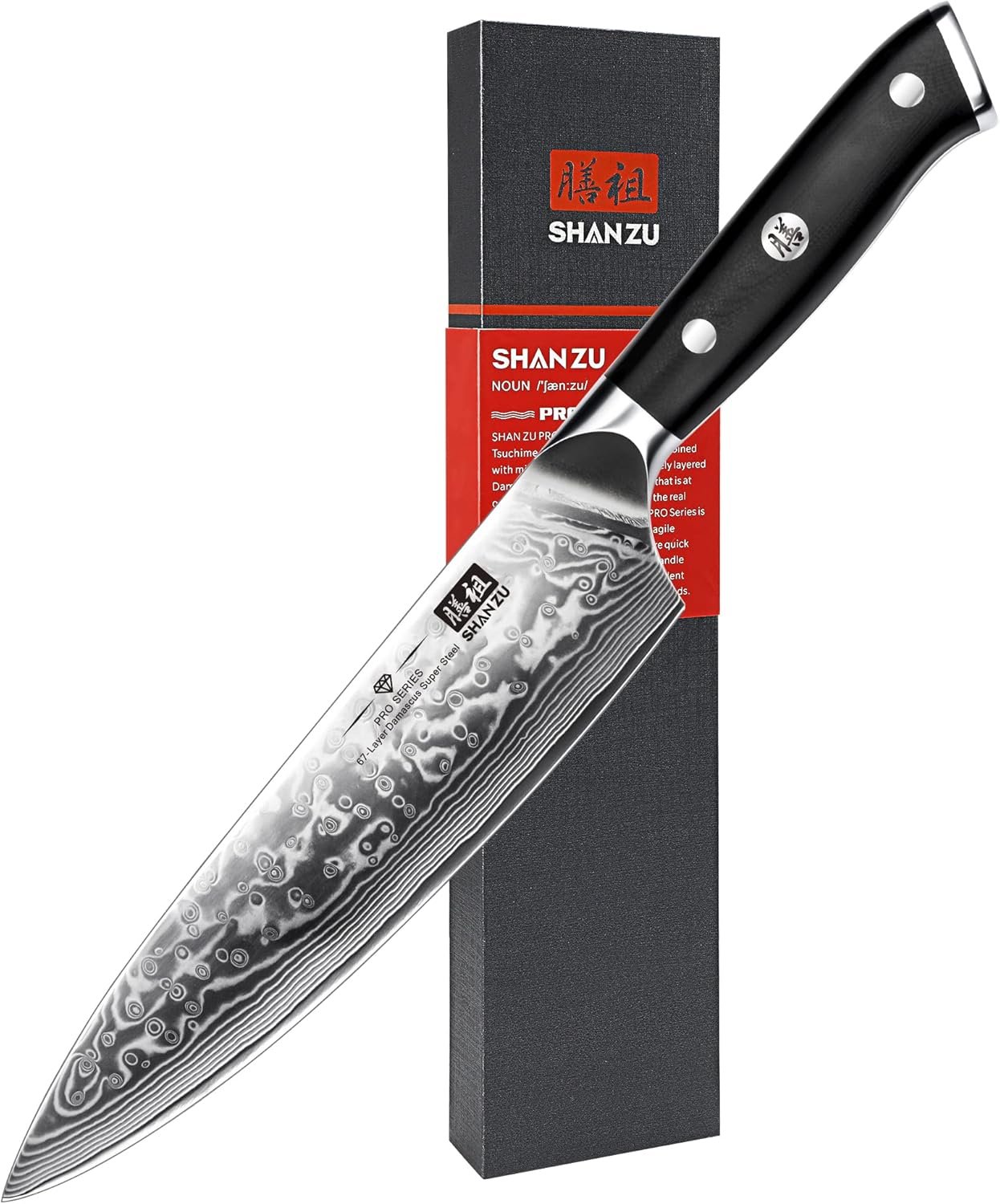
| 10Cr15MoV | 59–61 | SHAN ZU Damascus, budget Japanese | Smooth ceramic rod |
| AUS-10 | 60–62 | Various Japanese knives | Smooth ceramic rod |
| SG2 / R2 | 62–64 | Miyabi 5000 MCD, Takamura | Smooth ceramic rod only |
| Aogami Blue #2 | 62–65 | Traditional Japanese carbon | Smooth ceramic rod |
What HRC Should You Look For?
For most home cooks: 56–58 HRC German-spec steel. Forgiving, easy to maintain, handles everything. Victorinox Fibrox Pro (56 HRC) and Wüsthof Classic (58 HRC) are the defining examples.
For precision-focused cooks: 60–61 HRC Japanese-spec. VG-10 and VG-MAX deliver genuine sharpness improvements with manageable maintenance. Tojiro DP Gyuto at 60 HRC is the best-value knife in this bracket.
For enthusiasts who maintain correctly: 62–64 HRC — SG2, FC61. The performance ceiling for production knives. Miyabi 5000 MCD at 63 HRC with a 9.5° edge delivers a cutting experience German steel cannot physically replicate. Requires quality whetstone technique, no pull-through sharpeners, no bone-in cuts.
Frequently Asked Questions
What HRC hardness is best for kitchen knives?
Is higher HRC always better?
How do I find the HRC of my knife?
Does a Japanese knife need different maintenance because of its HRC?
📚 Related FOGAMA Guides