High Carbon Steel Chef Knives — Complete Guide 2026
Last reviewed: April 2026 | FOGAMA Editorial Team
⚠️ Affiliate Disclosure: Some links are affiliate links. Learn more. 📅 Last reviewed: April 2026
High carbon steel chef knives sit at an interesting intersection: they can take a sharper edge than most stainless steel knives, they sharpen more responsively, and they develop a distinctive patina over time that many cooks prize. They also rust if you leave them wet for ten minutes. Understanding that trade-off — and whether it suits your kitchen — is what this guide is for.
What Is High Carbon Steel in Kitchen Knives?
In kitchen knife terms, “high carbon steel” refers to steel with carbon content of approximately 0.8–1.5% (sometimes higher in specialist steels). Carbon is the element that primarily determines how hard steel can become during heat treatment — more carbon enables higher hardness, which in turn enables sharper edges and better edge retention.
The contrast is with standard stainless steel, which adds chromium (typically 13–15%) to the alloy to provide corrosion resistance. Chromium achieves this by forming a protective oxide layer on the steel surface. The trade-off: chromium slightly limits the maximum hardness achievable and the sharpness of the final edge. High carbon steels without sufficient chromium can reach higher hardness — and sharper edges — but at the cost of that protective oxide layer.
The practical result: a high carbon steel knife can be made sharper and holds that edge longer than most stainless alternatives at the same price point. But it requires immediate drying after washing, occasional oiling for storage, and will develop rust spotting if neglected. It is a commitment, not an inconvenience.
High Carbon Steel vs Stainless Steel — Key Differences
| Property | High Carbon Steel | Stainless Steel |
|---|---|---|
| Max hardness | 62–67 HRC achievable | 56–62 HRC typical for kitchen use |
| Edge sharpness | Sharper possible edge | Very sharp — but not quite as acute |
| Edge retention | Excellent to outstanding | Good to excellent |
| Sharpening ease | Easier — responds quickly to whetstone | Harder at equivalent HRC |
| Rust resistance | Low — will rust if left wet | High — chromium oxide protection |
| Patina development | Develops natural patina over time | No patina — stays bright |
| Maintenance demand | High — dry immediately, oil for storage | Low — wash and dry |
| Price range | Budget to premium | Budget to premium |
Common High Carbon Steel Grades in Kitchen Knives
Aogami (Blue Steel) Series
Aogami (Japanese: blue steel, named after the blue paper the steel is wrapped in) is one of the most respected high carbon steel grades in Japanese knife making. The Aogami series includes Blue #1 (higher carbon, harder) and Blue #2 (slightly lower carbon, easier to sharpen) variants. Hardness typically reaches 62–65 HRC. The Aogami Super variant adds tungsten and molybdenum for improved wear resistance. Used by high-end traditional Japanese knife makers.
Shirogami (White Steel) Series
Shirogami (white steel) is a very pure high carbon steel with minimal alloying elements beyond carbon and iron. White #1 and White #2 variants differ in carbon content. Hardness reaches 60–65 HRC. Shirogami takes the finest possible edge of any kitchen knife steel — professional sushi chefs who demand the sharpest possible blade reach for this. The catch: it is the most reactive steel in common kitchen use. It will rust in minutes if left on a wet chopping board. Maintenance is not optional; it is continuous.
10Cr15MoV / 10Cr15CoMoV (Chinese High Carbon Stainless)
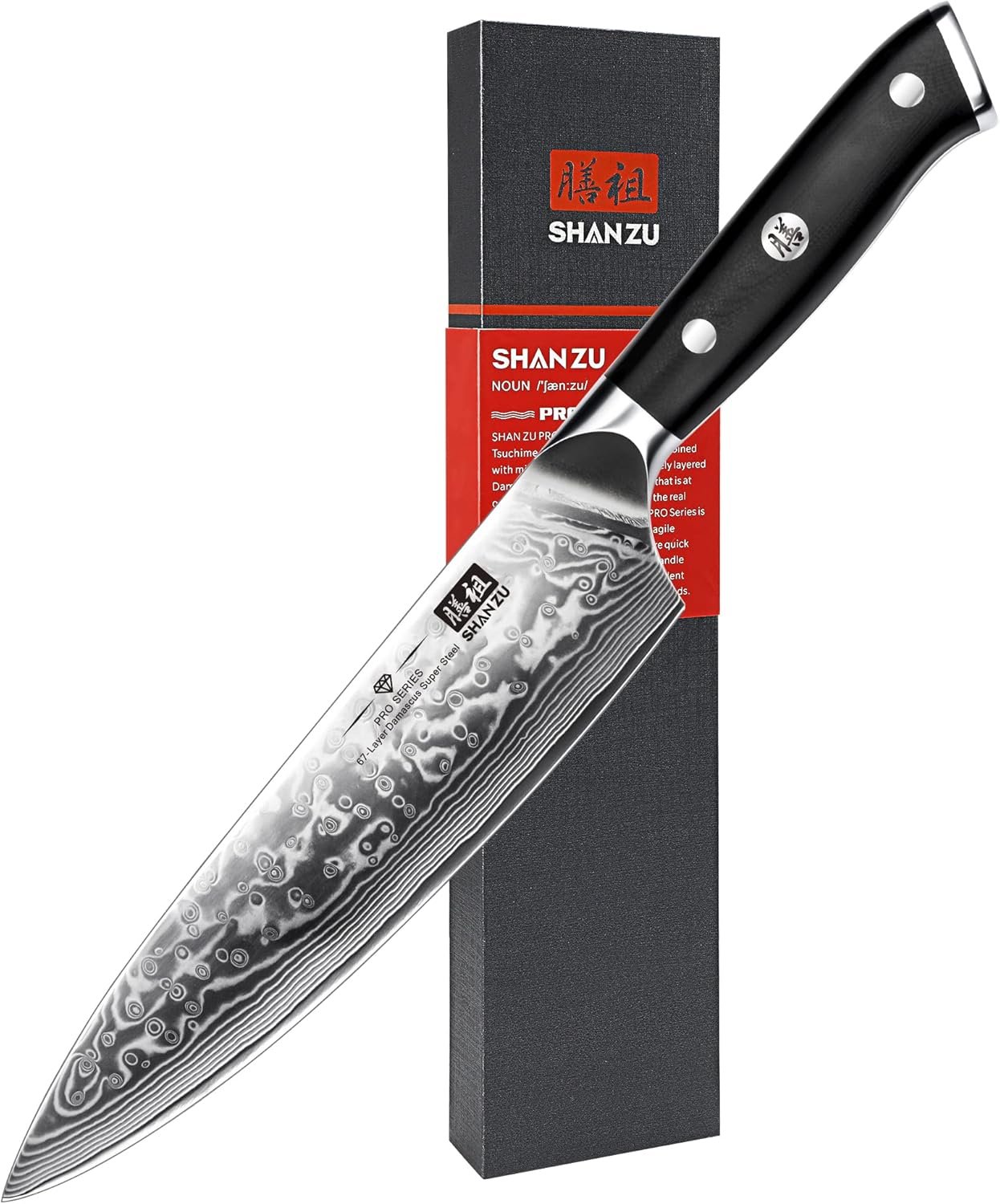
These are high-carbon stainless steels — they sit between pure carbon steel and conventional stainless. With carbon content around 1.0% and chromium around 15%, they achieve 59–61 HRC while retaining reasonable corrosion resistance. Used widely in accessible Japanese-spec knives including the SHAN ZU Damascus range. Not as reactive as traditional carbon steels, but not as corrosion-resistant as full stainless.
1084, 1095 (Western High Carbon Steel)
Simple high carbon steel grades used in Western knife making, custom blades, and traditional Japanese knives intended for Western markets. Carbon content around 0.84–0.95%. Typically reaches 55–60 HRC in kitchen knife applications. Good toughness, easy to sharpen, requires careful drying and occasional oiling.
The Patina — Feature or Problem?
When carbon steel reacts with acids and moisture from food (onions, tomatoes, citrus), it develops a dark grey-blue-black patina. This patina is not rust — it is a stable iron oxide layer that actually provides some passive protection against further corrosion and can reduce food reactivity over time.
Many cooks and professional chefs prize the patina aesthetic. It gives the knife a distinctive, individual character that stainless steel never develops. Newly patinated knives can impart a metallic taste to reactive foods (onions, citrus) — this diminishes as the patina stabilises, usually within a few weeks of regular use.
If you find the patina aesthetically interesting and don’t mind the maintenance commitment, carbon steel is genuinely rewarding. If you want a knife that looks the same on day 1 and day 1,000, stainless is the correct choice.
Top High Carbon Steel Chef Knife Picks
Tojiro Zen FD Series — Carbon Steel
Tojiro produces a dedicated carbon steel line (the Zen FD series) for cooks who want the sharpening responsiveness and edge quality of traditional carbon steel with manageable maintenance. Available in multiple profiles including gyuto and santoku. Aogami core steel, Western-compatible handles. ~£80–120. See our Japanese knife guide →
Sakai Takayuki Aogami Series
Sakai Takayuki is one of Japan’s longest-established knife makers. Their Aogami series delivers traditional Japanese carbon steel craftsmanship in accessible formats. Hand-forged, individual character, exceptional edge quality. Requires serious carbon steel maintenance commitment. From ~£150. For experienced cooks only.
Mercer Culinary Genesis Series
For home cooks wanting to try high carbon steel without significant investment. Mercer’s Genesis knives use X50CrMoV15 — technically a high carbon stainless steel rather than pure carbon steel, giving the edge performance benefits with more corrosion resistance. ~£30–50. See budget knife guide →
High Carbon Steel Maintenance — Non-Negotiables
- Dry immediately after every use: Carbon steel will begin rusting within minutes of being left wet. Hand wash, dry thoroughly with a clean cloth. No air drying.
- Oil for storage: A thin coat of food-safe oil (camellia oil is traditional; mineral oil works) before long-term storage prevents oxidation. Apply with a cloth, store horizontally or on a magnetic strip.
- React to rust spots immediately: Fine rust spots can be removed with a cork and powdered cleanser or fine steel wool. Treat as soon as spotted — left unaddressed, rust penetrates.
- Sharpen on a whetstone: High carbon steel responds beautifully to whetstone sharpening — it takes an edge faster than stainless steel at equivalent hardness. A 1000/6000 combination stone handles all routine maintenance.
- Never dishwasher: Carbon steel and dishwashers are fundamentally incompatible. The combination of prolonged water contact, alkaline detergent, and thermal cycling causes rapid, serious corrosion.
Frequently Asked Questions
Are carbon steel chef knives better than stainless?
Will a carbon steel knife rust if I wash it normally?
What is the difference between carbon steel and high carbon stainless steel?
Is a carbon steel knife good for a beginner?
What does “10Cr15MoV” mean on a knife listing?
📚 Related FOGAMA Guides